
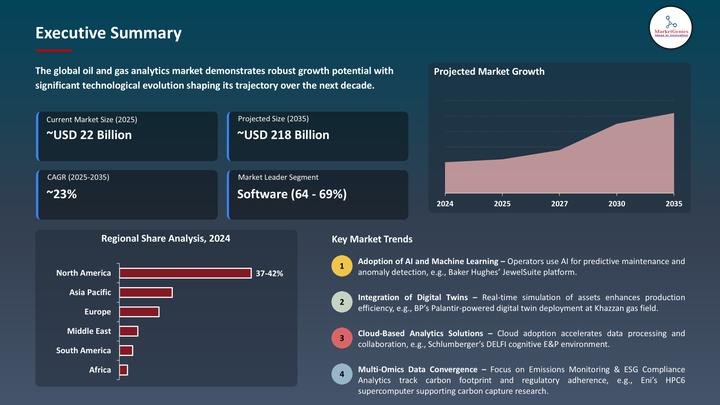

The oil and gas analytics market is poised for transformative growth, forecasted to reach an astounding **USD 218.3 billion by 2035**, with an estimated **USD 196.1 billion in new opportunities** driven primarily by advances in artificial intelligence (AI) and cloud-native predictive solutions. This surge reflects the sector’s rapid adoption of cutting-edge technologies that enhance operational efficiency, reduce downtime, and optimize resource management amid evolving energy demands and regulatory landscapes.
## Market Growth Dynamics and Key Drivers
The oil and gas analytics market is expanding at a compound annual growth rate (CAGR) of over 23%, fueled by the increasing integration of AI-powered predictive maintenance, digital twin technologies, and cloud platforms. These innovations empower companies to analyze vast datasets in real time, significantly improving asset performance and decision-making processes across upstream, midstream, and downstream operations.
One of the primary growth drivers is the industry’s imperative to minimize operational costs and avoid unscheduled downtime, costly in a sector where equipment failure can halt production for extended periods. Predictive analytics systems use sensor data and machine learning algorithms to forecast equipment failures before they occur, enabling preemptive maintenance interventions that reduce repair costs and optimize production schedules.
Another crucial factor is the increasing complexity of exploration and reservoir management. AI models enhance seismic data interpretation and reservoir simulations, enabling more accurate identification of oil-bearing structures and maximizing extraction efficiency. These capabilities shorten project lead times and improve recovery rates, offering a competitive edge in a capital-intensive industry.
## Role of AI and Cloud-Native Predictive Solutions
### AI-Driven Predictive Maintenance
Artificial intelligence is at the forefront of revolutionizing predictive maintenance, dramatically reducing unplanned downtime by continuously monitoring equipment health. AI algorithms analyze historical and real-time data, detecting subtle anomalies that precede mechanical failures. This proactive approach not only prevents costly outages but also extends asset lifecycles and improves safety by anticipating hazardous conditions.
### Digital Twin Technology
Digital twins—virtual replicas of physical assets—are becoming integral tools in oil and gas analytics. Coupled with AI, digital twins simulate real-world operations, allowing engineers to test scenarios, predict equipment behavior, and optimize parameters without physical intervention. This capability accelerates troubleshooting and enhances efficiency, especially in remote or high-risk environments.
### Cloud-Native Platforms and Integration
Cloud-native analytics platforms facilitate scalable, flexible data processing and storage, which is critical given the sheer volume and velocity of data generated in oil and gas operations. These cloud-based solutions enable seamless integration of AI models, real-time monitoring, and collaboration across global teams. By leveraging cloud infrastructure, companies achieve faster insights, reduce IT overheads, and improve responsiveness to market fluctuations.
## Expanding Opportunities Across the Oil and Gas Value Chain
The adoption of advanced analytics is reshaping multiple segments within the oil and gas value chain:
* **Upstream:** AI-enhanced exploration, drilling optimization, and reservoir management improve discovery success rates and production efficiencies. Real-time data processing during drilling operations allows dynamic adjustments, reducing operational risks and costs.
* **Midstream:** Predictive analytics optimize pipeline integrity management, minimizing leak risks and maintenance expenses. Supply chain analytics improve demand forecasting, inventory management, and logistics efficiency, ensuring timely delivery of materials.
* **Downstream:** Refineries utilize AI for process optimization, quality control, and energy management, driving cost reductions and environmental compliance.
Moreover, analytics solutions are pivotal in supporting energy transition initiatives, including carbon tracking, hydrogen production, and integration of renewables, helping industry players align with sustainability goals while maintaining profitability.
## Challenges and Future Outlook
While the market outlook is exceptionally positive, challenges persist. Integrating AI and cloud technologies requires substantial investments in data infrastructure and skilled personnel. Data security and privacy concerns also necessitate stringent safeguards, especially in cloud deployments.
However, continuous advancements in machine learning, edge computing, and digital twins promise even greater improvements in predictive accuracy and operational agility. As AI models evolve to handle increasingly complex datasets, oil and gas companies are expected to unlock further efficiencies and realize substantial value from data monetization initiatives.
The oil and gas analytics market stands at the cusp of a digital revolution, with AI and cloud-native predictive solutions driving unprecedented growth and innovation. By embracing these technologies, the industry is not only enhancing operational resilience and cost efficiency but also strategically navigating the transition toward a more sustainable energy future.